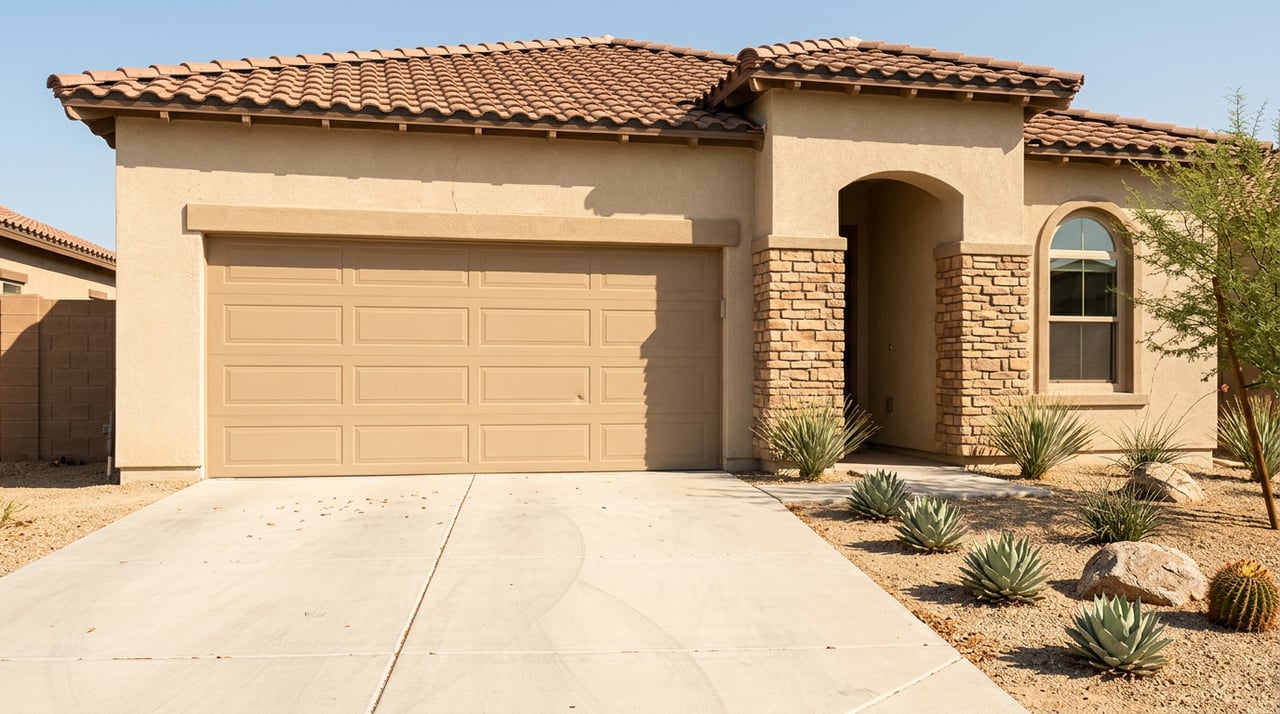
Queen Creek's Median Price Is the Least Useful Number in Your Search Right Now
August 6, 2026
August 6, 2026
Two buyers write offers on Queen Creek homes in the same week this summer. Both accept a $665,000 sales price. One walks into a payment that is roughly $400 per month lower than the other for the first three years. The gap has almost nothing to do with negotiation and almost everything to do with two line items neither buyer saw on the portal.
If you have been comparing Queen Creek to Gilbert or Chandler by scrolling median-price cards, you have been comparing the wrong number. The mid-2026 Queen Creek market is a story about what happens after the sticker: builder-funded rate buydowns pulling new-construction payments below prevailing resale rates, and Community Facilities District assessments pulling total ownership costs the other way inside certain master-planned communities. Whichever side of that spread you land on decides what your money actually buys.
Even the median itself refuses to sit still. Depending on where you look in June and July 2026, Queen Creek's median comes back at $718,500 for resale single-family homes in June 2026 across 70 Cromford Report transactions, a broader $665,000 blended median across roughly 148 closed sales with 96 average days on market, $619,000 on Redfin's three-month trailing read through May 2026, or a $675,000 list-price median in July 2026 on Movoto. Same town, same summer, six-figure spread.
The spread is the story. Resale-only cuts run higher because new-construction closings drag the blended median down through incentive-heavy pricing on smaller floor plans, while the note rate a buyer actually pays on those new builds sits well below what a resale buyer is quoted on the same day. That is the mechanism worth understanding before you decide which side of the ledger to shop.
Here is what the math looks like when you put a resale purchase and a new-build purchase next to each other at the same headline price this summer in Queen Creek.
| Line item | Resale in an established subdivision | New build with active builder incentive |
|---|---|---|
| Sales price | $665,000 | $665,000 |
| Note rate | ~6.2% prevailing | Buydown to ~5.25%, or lower in year one under a 3-2-1 structure |
| Annual property tax (approx. 1% of value) | ~$6,650 | ~$6,650 |
| CFD assessment | Typically none in older resale tracts | Hundreds to low thousands per year in some master-planned communities |
| Design studio / upgrades already in price | N/A | Often $50,000–$150,000 baked in |
| Closing-cost credit | Whatever you negotiate | Up to $25,000 available at aggressive communities |
The roughly 6.2% mortgage rate and 97.5% sale-to-list ratio in June 2026 describes the resale column. The new-build column is being written by builders who would rather spend money on rate than cut the sticker, because a lower sticker resets comps for every phase behind them. That is why the median has held roughly flat year over year while the monthly payment on a new build has fallen sharply.
Queen Creek's growth has been paid for, in large part, by Community Facilities Districts. These are special taxing districts layered over specific master-planned communities to fund roads, water infrastructure, and neighborhood parks. As many Queen Creek new construction communities sit inside Community Facilities Districts that add an annual assessment on top of base property tax, and CFDs can add hundreds to thousands per year to total housing cost, buyers should ask the builder rep to put the full annual property tax plus CFD assessment in writing before signing.
Portal estimates do not model this. A Zestimate showing $4,800 in annual taxes on a $665,000 home in a CFD community can be off by a full mortgage payment once the assessment is layered in. The fix is not complicated, but it is manual: pull the parcel, ask the builder for the current-year CFD schedule in writing, and add it to the escrow analysis before you fall in love with a floor plan. Older resale tracts in Queen Creek generally sit outside the newer CFDs, which is one of the quiet reasons a slightly higher resale sticker sometimes pencils to a lower total monthly cost than the new build across the street.
The most concrete example of the incentive stack in the market right now is Shea Homes at Ascent at Jorde Farms. On select quick move-in homes, Shea is offering a 30-year fixed conventional mortgage at a 4.99% note rate (5.368% APR) with a 3-2-1 temporary buydown, where a portion of the payment for the first three years is prepaid by the seller into a custodial escrow, with a temporary payment rate 3% lower in year 1, 2% lower in year 2, and 1% lower in year 3, and a total incentive value up to $30,828. The offer is tied to new contracts on select quick move-in homes executed after 4/22/2026 that close on or before 7/20/2026, and the pool depletes as homes go under contract.
Translate that: a buyer moves into a first-year payment rate under 2% while the note rate underneath is under 5%. Nothing in the resale column can compete with that year-one number. What the resale column offers instead is a house that already has landscaping, window coverings, and no design studio invoice to reconcile.
Every builder incentive of this scale comes with a lender attached. Buyers of Shea Homes are not required to use Shea Mortgage and are free to use any lender of their choosing, and are free to decline any incentives tied to the use of Shea Mortgage. That language is standard across the industry, and it exists because the incentive is real value the builder is spending on your behalf, but only if you take their financing package.
The catch worth knowing before you sit down at the sales gallery is that the preferred lender's base pricing, fees, and lender credits can differ from what an independent broker would quote you. The incentive is not free money. It is the builder buying down a specific loan product from a specific lender, and the only way to know whether it beats the market is to run one outside quote in parallel. A local agent who has watched several of these deals close can tell you within an hour whether the package is worth the tie-in on the community you are shopping.
The sales gallery walks you through a beautifully staged model. The design studio invoice comes later, and it is where new-build budgets go sideways. Builder design studios in Queen Creek offer hundreds of upgrade options including flooring, countertops, cabinets, fixtures, extended patios, and pre-plumbing for water softeners, and it is common for buyers to add $50,000 to $150,000 in design studio upgrades to a Queen Creek new build; prioritize structural options like room additions and extended patios that cannot easily be added later, and handle cosmetic upgrades like backsplash tile or light fixtures after close, where your dollar goes further.
A short discipline that pays for itself:
The upgrade line is the part of the new-build equation that most quickly closes the value gap against resale. A comparable resale home already has plantation shutters, upgraded lighting, mature trees, and a paver patio, and the previous owner paid for all of it in dollars that no longer show up in your amortization schedule.
The buyer who lands on Queen Creek after touring Gilbert usually does so because the same monthly payment carries a larger house on a larger lot. That geography is real. Gilbert is approaching its final population capacity of around 330,000 by 2030 and new construction is scarce, so buyers there are primarily shopping the resale market and competing for older homes, while Queen Creek has a deep pipeline with over 18 active builders and thousands of permits, giving buyers leverage including builder-funded interest rate buydowns to around 5.25% and up to $25,000 in closing cost credits. On a price-per-square-foot basis and with the buydown in place, the same qualified buyer can get meaningfully more house in Queen Creek this summer.
The tradeoff is the CFD line and the design studio discipline. If you go into Queen Creek understanding both, the leverage is genuine. If you go in reading the median off a portal card, you will pick the wrong side of the comparison.
Do all Queen Creek new-build communities have a CFD? No. CFDs are attached to specific master-planned developments, generally the newer ones where roads and infrastructure were bond-financed. The builder rep is required to disclose the current assessment, and the parcel record confirms it. Ask before you sign a reservation, not after.
Is a 3-2-1 buydown worth taking if I might refinance in two years? It depends on how the incentive is structured. In a true escrowed temporary buydown, unused funds typically credit against the loan if you refinance or sell early, so you rarely lose the full incentive. Confirm the language in the buydown agreement itself, not the marketing sheet.
Are older Queen Creek resale homes actually cheaper to own once you add everything up? Sometimes, particularly outside CFD boundaries and in neighborhoods where landscaping and window coverings are already in. The honest answer requires a side-by-side on two specific homes with two specific rate quotes, which is exactly the exercise most portal shoppers skip.
If you are weighing a new build against a resale in Queen Creek this summer, the productive next step is a two-column payment sheet built on the actual homes you are interested in, with the CFD, the buydown, and the upgrade budget all on paper. That is the conversation Brittany Arnett has with East Valley buyers every week. Let's find your next home.
Stay up to date on the latest real estate trends.
Whether you’re buying your first home or selling your current one, Brittany Arnett delivers hands-on support, strong negotiation, and local market knowledge to help you win in Mesa real estate.
BRITTANY ARNETT
2233 S Springwood Blvd Mesa AZ 85209