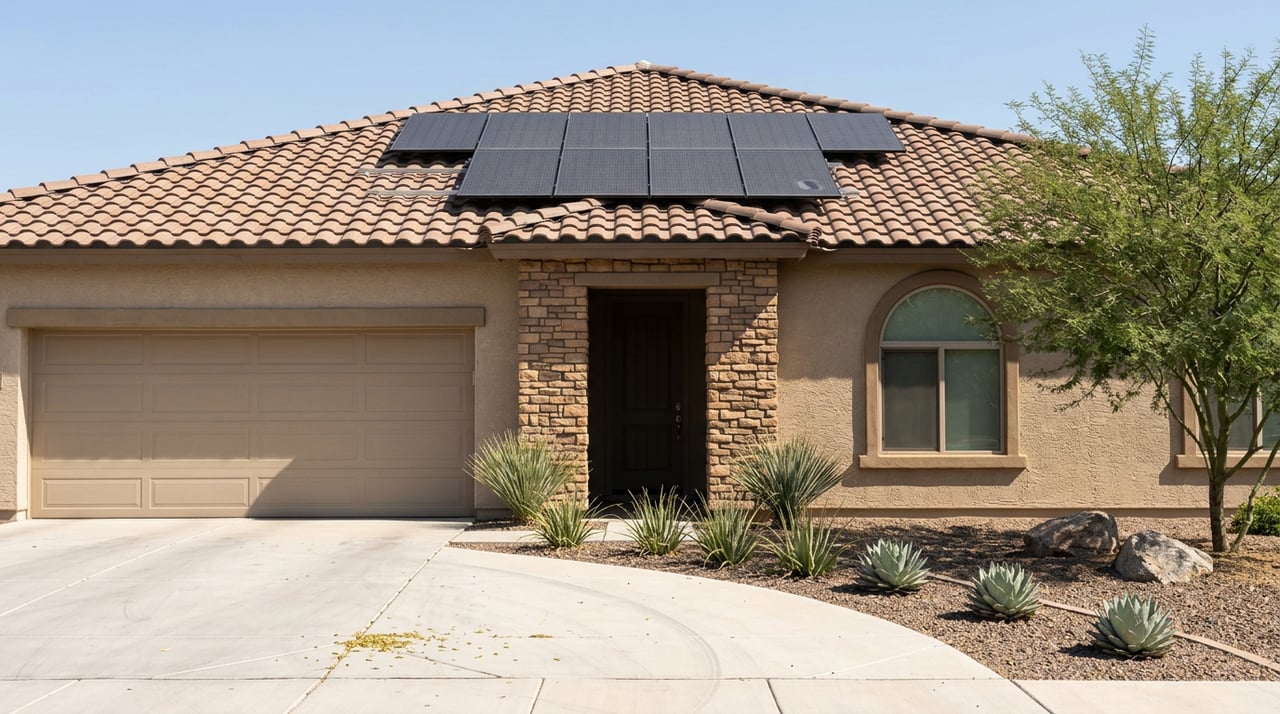
In Chandler, a Leased Solar System Doesn't Kill a Sale. Running Out of Time Does.
August 13, 2026
August 13, 2026
Most Chandler sellers with panels on their roof ask the wrong question. They want to know if their buyer will be willing to take over the lease. That's rarely where a deal falls apart. The real risk is whether the paperwork clears before the closing date does, and in 2026 that clock runs on a schedule most sellers have never seen until they're already living inside it.
Chandler has more of these transactions than almost anywhere else in the East Valley. With over 300 sunny days a year and roughly 6.5 peak sun hours daily, it's one of the strongest solar climates in the country, and a large share of the city's newer subdivisions were built solar-ready from the start. Add an active new-construction pipeline from builders like Shea Homes, Taylor Morrison, Lennar, K. Hovnanian, and Tri Pointe, and you get a resale market where leased solar shows up on listing after listing, not as an exception but as a routine line item.
Here's the mechanic that catches sellers off guard. A leased solar system isn't just a monthly bill the buyer agrees to inherit. The company that owns the panels typically files a UCC-1 financing statement against the equipment, similar to how a lender files a lien against a car. Title has to clear, subordinate, or insure around that filing before the sale can close cleanly. That's a separate process from the mortgage, running on its own timeline, handled by a company that has no obligation to move at the pace your escrow does.
Layered on top of that is the lease itself. The buyer doesn't just sign an acknowledgment. They apply to the solar company to assume the remaining contract, which means submitting to a credit check and approval process that has nothing to do with their mortgage underwriting. Two separate approvals have to land inside the same closing window, from two organizations that don't talk to each other.
This isn't a hypothetical risk. It's exactly the problem the Arizona Association of REALTORS® rewrote its Solar Addendum to address. The revision, released around November 1, 2025, exists specifically because of complications from solar companies filing bankruptcy, and it moves up the timeline for when a buyer has to start the lease or loan assumption process during escrow. In practice, a buyer typically receives the solar company's assumption approval documents a few weeks into escrow, and the new form gives them clearer guardrails for reviewing those terms against what they thought they were agreeing to, according to a session recap from the Central Arizona Association of Realtors.
That's a meaningful signal. Industry forms don't get overhauled because a process is working fine. They get overhauled because agents kept hitting the same wall at the same point in escrow, usually right when a solar company's slow response or shaky finances collided with a closing date that had already been set.
A leased solar system doesn't add a yes-or-no decision to your sale. It adds a second closing that has to finish inside the first one.
Assuming a solar lease generally requires the buyer to clear a credit threshold of 700 or higher, a bar that has nothing to do with whether they qualify for their mortgage. A buyer can be fully approved by their lender and still get declined by the solar company, and that decline can surface with only days left before the scheduled close. It's one more reason your buyer pool for a solar-leased home is narrower than it looks on paper, and one more reason the seller who plans for this ahead of time has more leverage than the one who finds out mid-escrow.
Something else shifted heading into 2026 that changes how buyers think about your system. The federal residential solar tax credit, the 30 percent write-off that made new installations dramatically cheaper, expired December 31, 2025 under the One Big Beautiful Bill Act. Anyone installing solar fresh in 2026 does it at full price, with payback periods stretching from the old 8-to-10-year range out to something closer to 11 to 14 years.
That makes an existing lease with a locked-in monthly rate look more attractive to a certain kind of buyer than it did a year ago, since they're not giving up a tax credit they could get elsewhere. But it only helps you if the assumption actually closes on schedule. A buyer who's drawn to the idea of inheriting your system for the savings still has to survive the same credit check and the same UCC-1 clearance as anyone else. The incentive shifted in your favor. The timeline risk didn't go anywhere.
This is also part of a broader pattern. Nationally, leased and PPA arrangements made up about 36 percent of residential solar projects as of mid-2024, up from 22 percent three years earlier. More leases in the market means more of these transactions run into the same paperwork sequencing problem, which is part of why the state association felt the form needed a rewrite in the first place.
There's no single right answer here. The right move depends on how much cash flexibility you have and how much runway is left on the lease.
| Approach | What it costs you | What it does for the sale |
|---|---|---|
| Pay off the lease before closing | Upfront cash at or before COE | Removes the assumption process entirely; system becomes owned, widening your buyer pool |
| Market the home with the lease in place | Nothing upfront, but adds a credit-check contingency | Keeps cash in your pocket, but ties your closing date to the solar company's approval speed |
| Offer a price concession if a buyer won't assume | Reduces net proceeds | Keeps the deal alive without a payoff, useful if the buyer is otherwise strong |
Whichever path you choose, the decision needs to happen before you list, not after an offer comes in. A buyer who falls for the house and then discovers the lease mid-inspection period is a buyer with new leverage to renegotiate.
If your Chandler home has a leased system, pull these together now rather than scrambling once you're under contract:
Having this ready before your first showing turns a potential mid-escrow scramble into a five-minute conversation with your buyer's agent.
Does having a leased system lower what I can ask for the home? Not inherently. The complication is procedural, not a mark against the property itself. A well-documented lease with a clear payoff number tends to move through escrow without issue. An undocumented one is where price pressure creeps in, because buyers discount for uncertainty, not for solar.
What if my buyer's lender has restrictions on assumed leases? Loan programs treat owned and leased systems differently, and it's worth confirming early with your buyer's lender rather than assuming every loan type handles an assumption the same way.
Can I just have the panels removed before selling? Technically yes, but removal usually requires paying out the remaining lease balance anyway, plus a contractor to detach the system and patch the roof. For most sellers, a clean payoff or a well-documented assumption is the faster and cheaper route.
A leased solar system on a Chandler home isn't a red flag. It's a scheduling problem with a known fix, as long as someone starts managing the timeline before the clock starts running against you. That's the difference between a solar lease that closes on time and one that becomes the reason your closing date moves.
If you're getting ready to list a Chandler home with a solar lease attached and want a straight answer on which path fits your situation, Brittany Arnett has walked East Valley sellers through exactly this. Let's find your next home.
Stay up to date on the latest real estate trends.

Whether you’re buying your first home or selling your current one, Brittany Arnett delivers hands-on support, strong negotiation, and local market knowledge to help you win in Mesa real estate.
BRITTANY ARNETT
2233 S Springwood Blvd Mesa AZ 85209